
Religion is becoming more important in Australian politics and this will pose fresh opportunities and challenges. Religion has always been important but the decline in Christian practice in recent decades led to a widespread assumption of religion’s decline in civic and political life.
However, according to Paul Kelly, this requires revision because of three epic global trends. These are the resurgence of Islam; a Christian revival in much of the developing world along with new Christians sects and old faiths being transplanted by immigrants; and an obligation upon political leaders to maintain the unity and cohesion of nations amid the growing trend to define identity by culture, religion or lack of religion.
Kelly argues that God is making a comeback. But there are lessons to be heeded. One, the churches and Islam in particular need to be mindful not to infringe the limits that exist on religious freedom. Two, the political secularists need to beware of propounding an exaggerated doctrine about the separation of church and state in Australia. And three, as values and religious ethics become more prominent in political debate there needs to be moderation on all sides.
(extract)
My theme in this lecture is that religion is becoming more important in Australian politics and this will pose fresh opportunities and challenges. Religion, of course, has always been important but the decline in Christian practice in recent decades led to a widespread assumption of religion’s decline in civic and political life.
This view I argue requires revision because of three epic global trends that also impinge upon Australia. These are the resurgence of Islam simultaneous with doctrinal and social fractures that provoke questions about Islam’s ability to reconcile with the secular state and that are ingredients in organised violence; a Christian revival in much of the developing world along with the growth in the multicultural societies of the New World of both new Christian sects and old faiths being transplanted by immigrants; and the twenty-first century obligation upon political leaders to maintain the unity and cohesion of nations amid the growing trend to defi ne identity by culture, religion or lack of religion.
While Australia is on the periphery of these global trends, they are refl ected in our politics. God is making a comeback, at least in much of the world. This trend is not suffi ciently grasped in Australia. Contrary to much Western orthodoxy from the Enlightenment onwards, modernisation and science have not killed religion. The collapse of the hierarchical Christian churches in Western Europe and their decline in Australia is more the exception than the rule. The irony is that as Europe abandoned religion it lost its fertility and is now heading into population decline.
The historical dimensions of this transition can hardly be overlooked—the purging of religion seems the prelude to a national twilight that will be dominated by new divisions and inequities generated by population ageing. In a review of the trends, Pew Forum’s Timothy Samuel Shah and Harvard University’s Monica Duffy Toft from the Kennedy School conclude: ‘The belief that outbreaks of politicised religion are temporary detours on the road to secularisation was plausible in 1976, 1986 and even 1996. Today the argument is untenable. As a framework for explaining and predicting the course of global politics, secularism is increasingly unsound.’1 This conclusion, if correct, constitutes one of the most radical messages for the current age.
That people do not live by reason alone is one of the great affi rmations of mankind’s current situation. In 1940 T S Eliott, fearing the secularist triumph, warned: ‘If you will not have God (and He is a jealous God), you should pay your respects to Hitler or Stalin.’ Eliot would be happier today.2 Those secularists who saw a new unfolding world of rationalism, tolerance, scientifi c progress devoid of the bogy of religion and religious superstition should be worried.
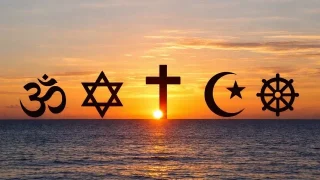
The global trend is unmistakable. Shah and Toft say that over the last 40 years the world’s largest global religions—Catholicism and Protestantism, Islam and Hinduism—have expanded faster than world population growth. A total of 64% of people on earth belong to these religions compared with 50% at the start of the twentieth century. The fi gure may be close to 70% within the next 20 years. They report that the upsurge applies to both numbers and devotion: ‘The most populous and fasting growing countries in the world, including the United States, are witnessing marked increases in religiosity. In Brazil, China, Nigeria, Russia, South Africa and the United States religiosity became more vigorous between 1990 and 2001.
Religion’s revival
What is driving this? Demography is one obvious explanation. But we need to look deeper. Samuel Huntington in his book The Clash of Civilisations says: ‘A global phenomenon demands a global explanation … The most obvious cause of the global religious resurgence is precisely what was supposed to cause the death of religion: the process of social, economic and cultural modernisation that swept across the world in the second half of the twentieth century.’
Huntington quoted Singapore’s Lee Kuan Yew who said: ‘If you look at the fastest growing countries—Korea, Thailand, Hong Kong and Singapore—there’s been one remarkable phenomenon: the rise of religion.’ The Islamic scholar, Gilles Kepel said: ‘Re-Islamisation “from below” is fi rst and foremost a way of rebuilding an identity in a world that has lost its meaning and become amorphous and alienating.’ In India a new Hindu identity is under construction as a response to the tensions from modernisation. In Russia, the religious revival is the result ‘of a passionate desire for identity which only the Orthodox church, the sole unbroken link with the Russians’ 1000 year past can provide. Political freedom and the struggle for freedom has become a catalyst for the religious revival.
There is a pattern at work—as greater political freedom came to nations as different as India, Mexico, Turkey and Indonesia the infl uence of religion on politics increased significantly. The Islamic resurgence in its good and evil dimensions has touched much of the world. It began with the 1979 Iranian revolution, extended to the Taliban’s rise in Afghanistan, the Shia revival in the Middle East, the 2006 election victory by Hamas in Palestine and, in its most violent and sinister form, the sectarian war in Iraq between Sunni and Shia where the US has come undone because it made the secularist judgement that Iraq post-Saddam Hussein would be governed by nationalism not religious identity. That was the wrong call.
Religion is becoming more important in the politics of South East Asia, notably in Malaysia and Indonesia. One of the major tasks of political leaders in these nations is to accommodate this rise but to quarantine the fundamentalists. At the extreme fundamentalism can turn into violence with the Bali bombers, who killed 88 Australians, being explicit during their trial about their perverted religious motivations and their desire to kill Jews and Christians.
Two years ago Malaysian Prime Minister Adbullah Badawi at a glittering Sydney dinner with several hundred guests devoted his entire 40 minute speech to a discussion of religion and Islam. There is still insuffi cient grasp in Australia that we live in an Islamic geography. This reality, however, will impinge increasingly upon our foreign policy options and style. It has now become apparent that economic globalisation of the past generation is not leading to one global culture but the reverse. Globalisation has provoked a stronger tide of nationalism and cultural assertion in which religion is a dynamic element. In much of the developing world nationalism and religion are marching together.
Huntington says the revival of non-Western religions is the most powerful anti-Western manifestation in non-Western societies. It is not a rejection of modernity; it is a rejection of the West. It is, he argues, a proud statement that: ‘We will be modern but we won’t be you. One of the most publicised aspects of religion’s revival is the rise of the Christian right in America and its mobilisation by President Bush.
The story has been presented by the quality media in Australia as an example of American exceptionalism and dysfunction. There is, however, no gainsaying the growth of grassroots Christianity and the evangelical churches in America nor their infl uence on its domestic and foreign policy. Within the US, values have replaced income as the dividing line of politics; the best indicator of support for Bush is not income but church attendance.
The close interaction between religion and politics is a defining feature of the Bush era. This is a unique American phenomenon and there are two trends at work. In America the hierarchical religions, notably the Catholic and mainstream Protestant churches have been in decline, undermined by a crisis of faith and institutional scandals.
The religious revival in the US is the latest manifestation of that decentralised, populist, market-based, evangelical impulse deeply embedded in the American psyche and soil from the foundations that provokes periodic surges of religious awakening. American utopianism and religious faith penetrate into the political arena as a belief in man’s ability to transform the world for the better.